From Founder To CEO
How To Make The Transition
I've been a founder and CEO for the last 23 years. Almost all of it self taught.
Over that time I've come to believe that founders can become great CEOs. The only way to get there is by doing it. Yes you can get a coach but that only takes you so far. At the end of the day you need time on the field making decisions, fucking up, and learning from your mistakes.
What makes this transition hard is it takes time. You acquire the hard skills by running enough companies with enough varying scenarios that you can build recognition patterns. The soft skills develop by leading people and making a lot of personal mistakes, many of them causing additional emotional stress. All of this often takes more practice than your current startup allows you.
You see a similar development happen with sports coaches. First time head coaches often fail, get fired, and connect the dots in their next head coaching role. Even Bill Belichick went from being a hugely successful assistant to a failed head coach to a record setting head coach (and back to a failing head coach).
Back to startups.
The intensity to start a company is so great that people don't do it for decades. They do it long enough to succeed or fail and then they stop founding because it's too hard. The end result is a network of fellow founders who can share broad learnings, but who haven't had the time to create their own methodology on developing from a founder to a CEO.
So I collected feedback from several who have made this transition and combined it with my own 23 years of experience. If I were to develop a founder into a CEO here is how I'd think about it.
Development Triangle
I think of developing from a founder to a CEO like this:
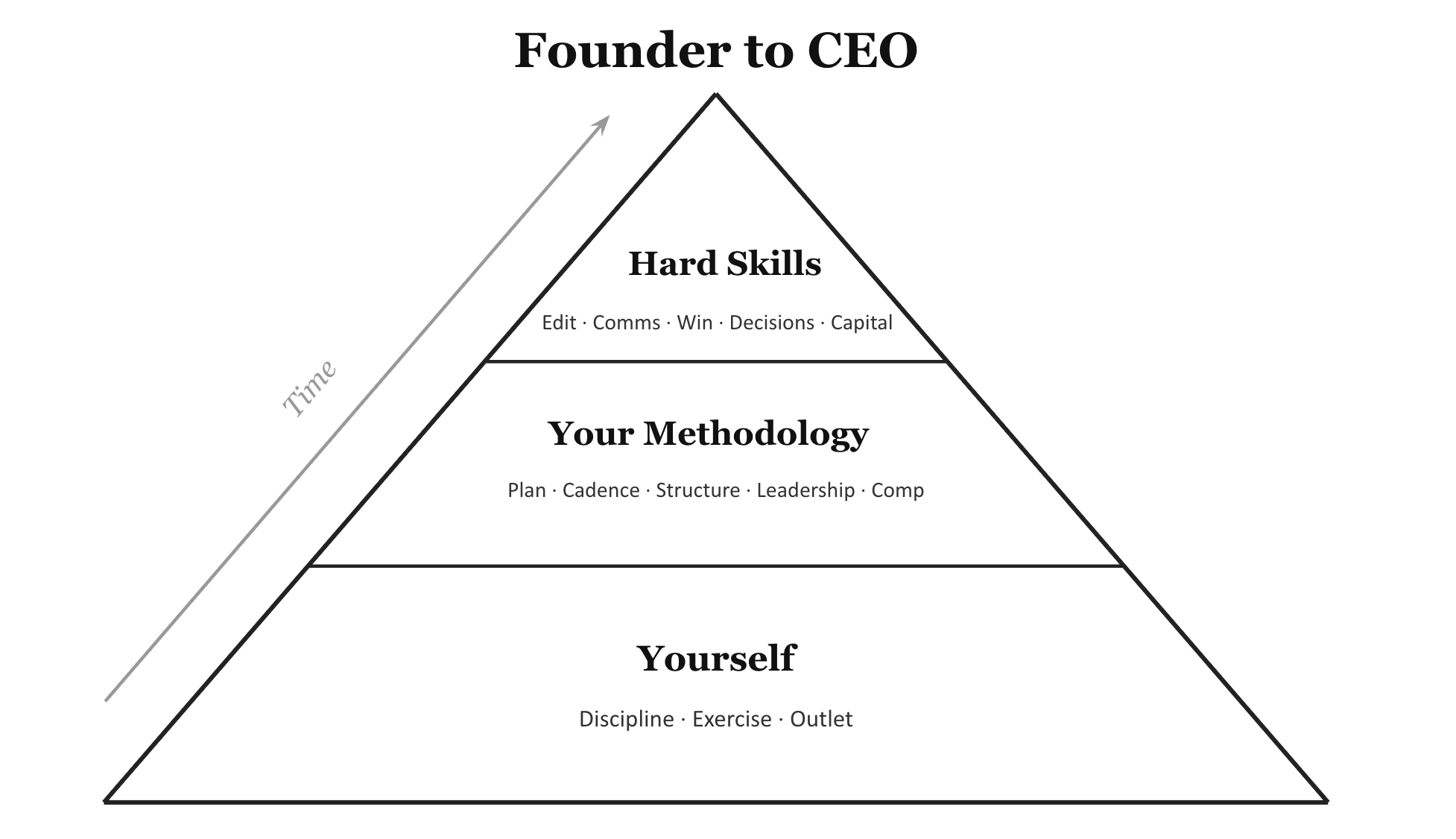
Yourself – no different than if you are trying to become a professional athlete.
Methodology – how you like to run a company. Hard Skills - the CEO functional skills you have to master.
The assumption is that you already have the personal foundation in place before you take the role. Developing all three parts of the triangle at the same time is really difficult.
Is It For You?
The prerequisite to developing as a CEO is time. It's not a role you learn quickly and it definitely isn't a role you master without a lot of mistakes. Even if you have success out of the gate everyone gets humbled at some point.
An alternative path is focusing on how to be a great founder. Understanding customer needs, building products that gain traction, and willing people to believe are very hard skills to master. It's ok spending your career just being a great founder.
Garrett Camp is a modern day example of this — starting StumbleUpon, Uber, and Expa. I haven't met Garrett but from the outside it appears he's obsessed about founding new ideas and teams.
There is no shame in just being an awesome founder. To found, start, and hand off companies can be personally rewarding and financially lucrative (i.e. Garrett is a billionaire).
The Foundation - Yourself
You need a strong base to make it as a CEO. It's a long game. It takes time to develop a company and even longer to develop your CEO philosophy. I believe in foundational building blocks that you will need to stay committed to over the long term.
Some of the core tenets I've found you need in your foundation.
Discipline
Cus D'Amato was Mike Tyson's coach. His philosophy was that will is more important than skill. You aren't born with skill — you have to practice and train to become the best.
This only happens with discipline. And no one can generate this for you. You have to find it and harness it until discipline becomes a personal habit.
Mine started as a kid with soccer. I wasn't always the fastest so I had to be the hardest worker. I'd train before school, after school, and then go to team practice. Fortunately this created a set of habits that I now heavily rely upon.
Discipline doesn't mean you can't be creative. I find the opposite to be true — the more disciplined you are the better your creative sessions become. You create with purpose and that keeps you from getting burned out.
Physical Exercise
This is hard to do consistently. It becomes easy with stress and travel to ignore how exercise is tied to your very survival. But it is. Consistent physical exercise is very much tied to your discipline so find a way to make it foundational to your life.
Emotional Outlet
You are going to need a place, or person, or a set of people that become your emotional outlet. Recognize this before you even start.
If you are founding a company and have a significant other, they are also founding the company with you. Talk about the why behind founding the company and what success looks like for the two of you. And you'll have to keep this conversation going as you level up in the CEO game. Each new level gets harder than the previous one and without emotional support you will break.
Being a parent is even better. Little kids keep you grounded and your desire to spend time with them keeps you highly efficient. They really don't care if you had a great day or a bad day. They just want to be with you.
The Middle - Your Methodology
Leading people is emotionally difficult. It's even harder if you don't have a methodology for how you organize and run your teams. The analogy is like coaching a sports team without any method for how you prefer to practice, prepare for games, play the games, or analyze the results.
Giving people structure is critical to reducing the emotional stress involved. It's better to start with something and modify it over time than to start with nothing.
There is no right way to do this. These are just tools I've found help in running a team.
North Star Plan
How do you prefer to communicate your vision? Which direction is the company heading? Where does the team need to be and how far into the future?
Everyone has their own method. I prefer a North Star document (where we are ultimately headed) and a rolling 12 month plan (where we need to be next). I prefer each to be a single page and written down because it scales no matter how many people you hire.
Cadence
What's the rhythm of your company? Is the team connecting daily or weekly? When do you review results? Sports teams have a clear cadence to their season — games, training, days off.
In running a company I prefer:
Rolling 12 month plan: far enough out, but not so far you lose sight.
Trimesters: 3x 16 week chunks, just enough time to make a real impact.
Monthly: A great financial check-in point. How are we doing?
Bi-Monthly: Company team call, keeps everyone connected.
Weekly: Team lead cadence. What's in your way?
Daily: In-team cadence for blockers and priorities.
Team Structure
You should have a way you like to organize and run teams. Is it functional, ownership, or business units?
I prefer an ownership structure where there is a clear owner for each area of the business we need to win at. I call it who owns what. I find this helps people focus on the work and not get distracted by functional hierarchies.
Leadership Development
How do you develop your teams? Do you teach people how to lead or do you only hire in leadership? Either is fine, you just have to be clear culturally about what your plan is.
Personally I've found the most success developing team leads from within. If you need to go faster this process will not work. The biggest challenge in hiring outside leadership is that they all bring their own system. You will have to make it clear you are hiring for their experience but you want them to adopt it to yours.
I'm a big believer in Keith Rabois' Barrels and Ammunition framework. I think of barrels as potential team leads — people who can own sections of the business. I also believe these team structures are temporary so I look for team leads that can pivot to running new teams or new sections of the business as we grow. These are not orgs, they are groups of 2-7 people focused on a single project or area at a time.
My own system:
Hire team leads from within. Who is a natural barrel?
Cross functional teams: each team runs with multiple disciplines.
Transparent tools: We use Notion and Slack, and all work is public.
Weekly updates: sharing across the company what the team did this week.
Teaching: I spend time teaching team leads how to manage people.
Compensation Philosophy
How you pay people matters. Are you going with the traditional negotiated model or a formula model? Are you going to offer equity or profit share? Are you going to pay above or below market?
I prefer a formula model, a simplified version of Buffer's salaries. A formula model removes a lot of the emotion around hiring, especially when people leave. It treats everyone the same so the team can focus on the work and not try to figure out why someone is making more than them.
The Functional Skills
My favorite book on this is Ben Horowitz's Hard Thing about Hard Things.
Many of the hard CEO skills are business model and market specific. Most of them are developed by fucking up before learning the right approach. The nice thing is these functional skills get easier over time.
Editing
As a CEO you are supposed to be an editor, not just a maker. Editing is the most important skill you have to develop.
As a founder you write, but as a CEO you edit. This means being able to listen, cut to the core, and pull out the key insights. It doesn't matter if it's a product, customer, or team issue — you have to learn how to cut to the core problem and communicate it.
A few tools I use to sharpen this skill:
Customer Journey – a mental map of before, during, and after. It helps you quickly map out a process to understand the core problems and identify what you don't understand.
Visual Hierarchy – a core element of design thinking. The arrangement of information implies importance. Getting good at this helps you structure the most important information up front — the problem, the why, and the what.
Skimming – if you can skim something and still understand it, the information is well organized. If it's too complicated to skim, something is wrong.
Malcolm Gladwell – he is incredibly succinct. Reading his work and listening to his podcasts you can learn from someone who distills complex topics in simple ways. Find communicators you believe are great editors and study them.
Communicating
You are the CEO. What you say matters. Learning this is painful as you transition from the early days when everyone personally knows you to the later days when very few people do. People will start reading everything you do and making assumptions.
Communicating is harder when you are wearing multiple hats. As you build out a leadership team there are times when you will hold dual roles and people will struggle to understand if you are speaking as the CEO or as the functional leader. It's your job to clarify.
What people want is:
Consistency. They don't like all your new ideas or changes to plans they already executed on.
Clarity. Be succinct and to the point so people can make decisions from what you say. Confidence. Being calm throughout the peaks and valleys gives people confidence they are making the right decisions.
Transparency. Don't underestimate the decisions people will make if they have the same information you do. When you are totally transparent and provide clarity around the why, people will follow you. When you start hiding things people will leave.
How You Win
You have to figure out what quadrant you can own in the market. This skill takes practice — looking at how the market traditionally competes without you and figuring out how you can win on a new paradigm. I call this finding your quadrant.
You learn to do this at a product level (how you differentiate) and at a business level (how you win the market). From that clarity you learn how to communicate and allocate resources to execute against your opportunity.
Making and Re-making Decisions
You have to learn how to make CEO decisions. Bezos had a two-way door concept — if a decision can't be reversed, think carefully. If you can decide and pivot back if it doesn't work, go quickly. The faster you go the faster you learn.
The hard skill here is admitting when the wrong decision was made. Changing direction isn't the hardest part — communicating why you are changing direction is. Every changed decision can instill a little doubt about your ability to lead.
Have a clear one-door / two-door philosophy. Learn to change decisions and communicate them well. Teach your team leads to do the same.
Capital
It's your job to make sure the team has the money it needs to execute. This can come from debt, equity, or profitability. It's on you to pick the right strategy and find the right partners.
Finding the right partners gives you rocket fuel. Finding the wrong ones is death by a thousand cuts. The skill to master is story and investor speak — learning how to simplify your business and find people who are excited about the wave you are trying to ride.
Investors are the one group you can't fire. But they can find a way to fire you.
Conclusion
This is a work in progress as I develop my own philosophies on making this transition. A lot of what I have learned has come through struggle. It's a struggle I love and try to get better at every day.
If you have more questions send me an email or dm on X.